

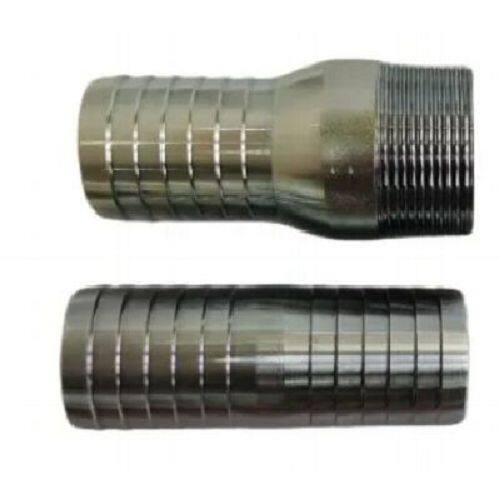
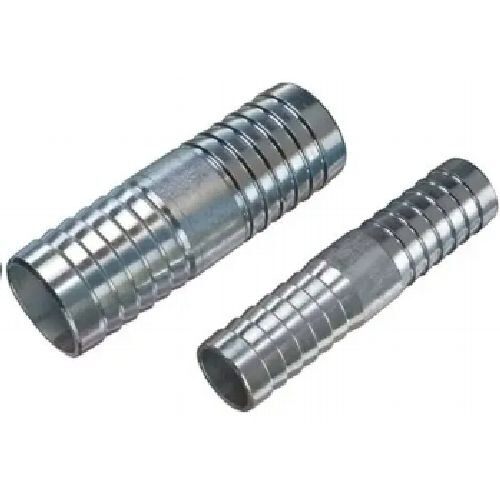
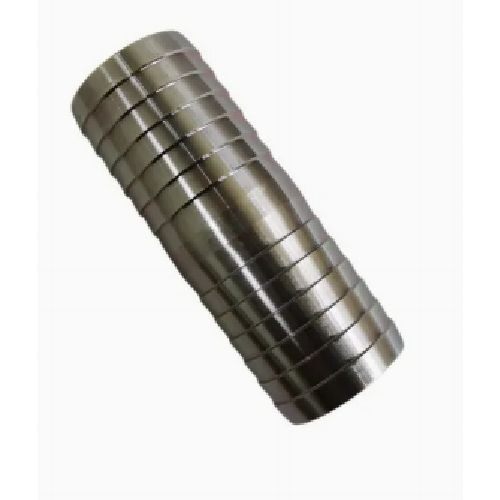
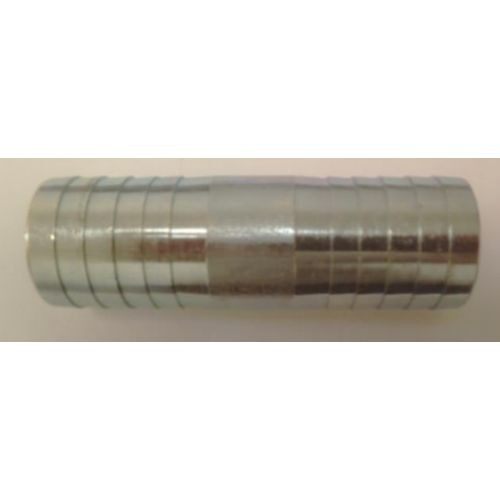
The Hose Mender is a double-ended barbed connector used to repair damaged hoses or join two separate hose lines of the same inner diameter.
Product Specifications
|
Product Specification |
Details |
|
Size Range |
DN15 (1/2") to DN300 (12") |
|
Barb Design |
CNC machined serrated barbs, tolerance ±0.05mm |
|
Working Pressure |
Up to 16 Bar (232 PSI) |
|
Wall Design |
Thick-wall structure for impact and pressure resistance |
|
Center Collar |
Prevents hose slipping and ensures proper installation |
|
Surface Finish |
Electro-polished or acid-passivated options |
|
Engineering Support |
3D STEP models and 2D drawings available |
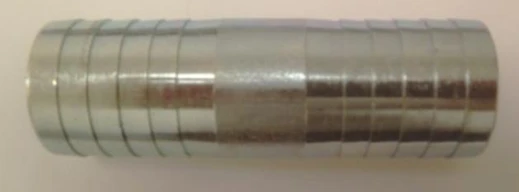
Barb Design
Optimized Barb Height
Ensures deep hose wall engagement without puncturing the inner liner during rapid manual assembly.
Controlled Barb Pitch
Distributes clamping pressure evenly to prevent hose-cover cutting and stress cracking during repeated bending.
Angled Serration Profile
Securely locks onto the tube's inner wall to withstand dynamic working pressures of up to 300 PSI.
Integrated Center Collar
Acts as a mechanical stop to ensure precise hose seating and consistent clamp alignment.
Applications
Agricultural Irrigation: Repairs severed drip lines and impacts sprinkler manifolds in high-density field distribution networks.
Industrial Compressed Air: Rejoins damaged 1/2" to 2" pneumatic rubber hoses operating under 8–10 Bar continuous pressure.
Commercial Washdown: Restores high-traffic washdown water lines in food processing plants and automated vehicle wash bays.
Fuel Oil Transfer: Splices fuel-resistant rubber lines for low-pressure diesel and lube oil supply systems.
Manufacturing Process
Raw Material Verification: Spectrometer-tested CW617N and C36000 brass verify exact alloy purity to ensure full RoHS compliance.
Hot Forging: High-density hot forging eliminates internal porosity, preventing structural burst failures under high pressure.
Precision Machining: CNC-machined barbs provide maximum hose retention while preserving inner tube liners during installation.
Pneumatic Leak Testing: 100% dry-air testing at 150 PSI verifies airtight sealing for every fitting before packaging.
Surface Passivation: Acid pickling removes oxidation scale, delivering clean, burr-free threads.
Supply Capability
300,000 Pcs Monthly Capacity: Automated forging presses and multi-axis CNC machines support high-volume OEM distributor contracts.
48-Hour Dispatch Stock: Standard sizes (1/2" to 1" NPT/G threads) are maintained in buffer inventory for fast dispatch.
Flexible MOQ & Fast Prototyping: Standard MOQ starts at 1,000 pieces, with custom OEM samples delivered within 10 business days.
Export-Ready Packaging: Packed in heavy-duty double-corrugated cartons on ISPM-15 heat-treated pallets for ocean freight protection.
Industry Standards & Compliance
Material Standards
Manufactured to ASTM B16/B124 and European EN 12165 brass material specifications.
Barb Geometry
Machined to align with EN 14420-3 and DIN 2817 heavy-duty hose clamp coupling standards.
Environmental Safety
Compliant with RoHS 3 (Directive 2015/863) and REACH regulations with zero restricted heavy metals.
Factory Certification
Produced in an ISO 9001:2015 certified facility featuring batch-level quality tracking systems.
FAQ
Q: Is brass suitable for long-term contact with diesel fuel and lubricating oil?
A: Yes, CW617N and C36000 leaded brass alloys show no significant corrosion or dimensional change from standard diesel or mineral lubricating oil exposure.
Q: Does the 16 Bar working pressure rating apply uniformly across the full DN15 to DN300 size range?
A: No, the 16 Bar rating applies to sizes DN15-DN100; larger sizes from DN125-DN300 are rated at a reduced 10-12 Bar due to increased wall stress at larger diameters.
Q: How can we request a copy of the PMI/XRF material verification report for a specific batch before shipment?
A: A batch-specific PMI report can be shared as a PDF within 2-3 business days of request, referencing the same heat number printed on the accompanying Material Test Report (MTR).
Q: What is the typical lead time difference between the 48-hour buffer stock sizes and larger custom DN200-DN300 sizes?
A: Standard 1/2"-1" buffer stock sizes ship within 48 hours; DN200-DN300 large-diameter sizes require full CNC machining from raw billet and take 15-20 business days.
Q: When should electro-polished finish be chosen over acid-passivated finish?
A: Electro-polishing is recommended for food-grade or highly visible washdown applications requiring a mirror-smooth, easy-to-clean surface, while acid-passivation is more cost-effective and sufficient for underground irrigation or industrial compressed air lines not requiring cosmetic finish.


